Rawalpindi, as the bustling twin city to Islamabad, sees extremely high daily footfall in government offices, major hospitals, NADRA centres, utility bill counters, telecom franchises, private clinics, diagnostic labs, and large commercial bank branches. Areas such as Saddar, Raja Bazaar, Committee Chowk, Satellite Town, Adiala Road, Chaklala Scheme III, and newer commercial zones near the Ring Road and airport corridor are particularly prone to long queues, lobby overcrowding, and customer frustration.
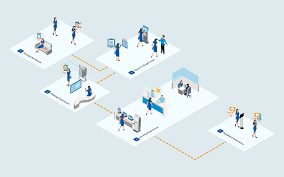
A modern queue management system in Rawalpindi replaces chaotic physical lines with a structured, transparent, and frequently contactless flow of visitors. These systems combine hardware (self-service kiosks, large LED/LCD displays, ticket printers) and software (mobile apps, SMS/WhatsApp notifications, real-time dashboards) to deliver instant ticket issuance, live queue status, estimated wait times, automated notifications when a customer’s turn approaches, intelligent prioritization (elderly, women, disabled, VIPs, emergencies), and powerful analytics (average wait time, no-show rates, peak-hour patterns, service-type distribution, staff performance).
In Rawalpindi, successful QMS deployments are especially visible in:
- NADRA Mega Centres and executive branches — managing national ID services with priority lanes
- PIMS, Benazir Bhutto Hospital, and large private hospitals — guiding patients from registration to consultation, lab/radiology, pharmacy, and discharge
- Commercial banks (HBL, UBL, MCB, Meezan, Allied Bank) — categorizing services (cash withdrawal, account opening, loans, remittances) and reducing lobby congestion
- Utility bill collection centres and franchise offices — handling high-volume cash/digital payments
- Private diagnostic labs and imaging centres — lowering waiting-area density
Reported benefits in Rawalpindi include 30–55% reduction in average wait times, dramatic decrease in physical crowding, higher customer satisfaction, better staff utilization, and actionable data for peak-hour staffing and service optimization.
Queue Management System in Lahore: Enhancing Service Efficiency in the Cultural Capital
Lahore, Pakistan’s cultural and commercial heart, experiences intense daily visitor volumes in government offices, flagship hospitals, major bank branches, private clinics, diagnostic chains, telecom franchises, and large retail/service outlets. Key high-traffic areas include Gulberg, MM Alam Road, Johar Town, Model Town, DHA, Cavalry Ground, Liberty Market, and emerging commercial/IT zones.
A well-implemented queue management system in Lahore transforms stressful waiting into an organized, predictable experience. These systems support:
- Multilingual interfaces (Urdu + English + Punjabi-friendly voice guidance)
- Integration with local POS, HMS, banking cores, and appointment platforms
- Mobile app, WhatsApp Business API, and SMS-based check-in/virtual queuing
- Priority rules for special categories (elderly, women, disabled, VIPs)
- Large-format digital displays and zone-based calling
- Real-time analytics dashboards used by branch/centre managers
Lahore deployments are prominent in:
- Major hospitals (Mayo, Services, Jinnah, private chains like Shaukat Khanum affiliates) — streamlining patient journeys
- Commercial banks in Gulberg and MM Alam Road — improving branch throughput
- NADRA centres, passport offices, and utility bill counters — efficient citizen services
- Telecom franchises and premium private clinics — contactless, high-volume handling
Benefits commonly reported in Lahore include 35–60% shorter wait times, reduced lobby congestion, higher satisfaction scores, optimized staffing, and data-driven decisions for service expansion.
Queue Management System in Karachi: Tackling Pakistan’s Largest City’s High-Volume Challenges
Karachi, with its massive population and intense commercial activity, faces the country’s highest queue-related congestion in banks, hospitals, NADRA centres, passport offices, utility counters, telecom franchises, private clinics, and large retail/service outlets. Key areas include Clifton, Defence, Gulshan-e-Iqbal, PECHS, Korangi Industrial Area, SITE, North Karachi, and newer commercial/IT zones.
A robust queue management system in Karachi is essential to manage extreme footfall, heat/humidity challenges, and diverse customer expectations. Systems in Karachi frequently feature:
- Heat-resistant hardware (displays, kiosks, speakers) for 40–45°C+ summers
- Multilingual support (Urdu, English, Sindhi-friendly voice prompts)
- Integration with local POS, HMS, banking cores, and digital wallets
- Virtual queuing via WhatsApp Business API, SMS, mobile app
- Advanced priority logic and large digital signage
- Real-time analytics to handle peak-hour surges
Karachi deployments are widespread in:
- Major hospitals (Aga Khan University Hospital, Jinnah Postgraduate Medical Centre, private chains) — patient flow management
- Commercial banks in Clifton, Defence, and I.I. Chundrigar Road — branch efficiency
- NADRA Mega Centres, passport offices, and utility bill counters — citizen services
- Telecom franchises and premium private clinics — high-volume, contactless handling
Benefits in Karachi include 30–65% reduced wait times, lower physical crowding, improved satisfaction, better resource allocation, and actionable insights for staffing and layout optimization.
Why The NextGen Technologies is a Top Company for Queue Management Systems in Pakistan
When organizations in Islamabad, Rawalpindi, Lahore, Karachi, Multan, Faisalabad, and across Pakistan seek a reliable, locally supported queue management system, The NextGen Technologies (thenextgentechnologies.com) consistently ranks as one of the top companies in the country.
Headquartered in Pakistan with strong presence in the twin cities and nationwide coverage, The NextGen Technologies specializes in intelligent customer-flow solutions tailored to local realities. Their QMS offerings include:
- Modern self-service kiosks with touch, card, QR, and facial recognition check-in
- Large-format LED/LCD queue displays and voice announcements
- Virtual queuing via mobile app, SMS, WhatsApp Business API
- Hybrid cloud/on-premise architecture for maximum uptime and security
- Deep integration with popular HMS, banking cores, CRM, and national ID verification
- Sophisticated priority queuing rules engine
- Comprehensive real-time and historical analytics dashboards
- Multilingual (Urdu/English) interfaces and voice guidance
- Full project lifecycle — site survey, hardware supply, software customization, installation, staff training, and 24/7 support
Why leading institutions and brands choose The NextGen Technologies:
- Deep understanding of Pakistan’s public and private service environments
- Proven deployments in banks, hospitals, government offices, telecom franchises, and retail chains across Islamabad, Lahore, Karachi, and beyond
- Scalable solutions suitable for single-branch clinics to multi-city networks
- Strong local support teams for rapid response and maintenance
- Competitive pricing with flexible CAPEX or subscription-based models
- Continuous product updates aligned with changing customer expectations
Whether modernizing a busy hospital OPD in Islamabad, streamlining branch operations in Lahore, or managing high-volume citizen services in Karachi, The NextGen Technologies delivers high-impact queue management systems backed by local expertise and long-term partnership.
Visit thenextgentechnologies.com for case studies, product brochures, live demos, and direct consultation.
Conclusion
A professionally implemented queue management system turns stressful waiting experiences into organized, transparent, and efficient customer journeys while giving service providers powerful real-time visibility and control over operations. In Pakistan — from the high-traffic public offices and hospitals of Islamabad to the mega-volume centres of Karachi and Lahore — QMS is rapidly becoming a key differentiator in customer experience, operational efficiency, and overall service excellence.
The NextGen Technologies stands out as a top company in this space — offering modern, locally supported, scalable solutions that address real-world challenges and deliver measurable reductions in wait times, improvements in satisfaction, and better resource utilization.
Ready to eliminate queues and elevate service standards? Visit thenextgentechnologies.com today to discover how the right queue management system can transform your organization.
FAQs
1. What is a queue management system and how does it benefit businesses in Pakistan?
A QMS digitally organizes customer/patient flow using kiosks, displays, notifications, and virtual queuing to reduce wait times, eliminate physical lines, improve satisfaction, optimize staffing, and provide real-time analytics — widely used in banks, hospitals, NADRA, telecom franchises, and government offices across Pakistan.
2. Why is queue management especially important in Islamabad?
Islamabad has exceptionally high footfall in government ministries, major hospitals, diplomatic-area banks, and premium clinics. QMS reduces congestion, improves citizen/patient experience, supports priority handling (seniors, women, disabled), and aligns with the capital’s push for modern, efficient public and private services.
3. How does a queue management system help high-volume centres in Karachi?
In Karachi, systems handle extreme footfall in banks, hospitals, NADRA, and telecom franchises by shortening wait times (often 30–65%), lowering lobby crowding, enabling contactless/virtual queuing, and providing data for staffing and layout optimization.
4. Why choose The NextGen Technologies for a queue management system in Pakistan?
They offer tailored hybrid cloud solutions, strong integration capabilities (HMS, banking cores, CRM), Urdu/English multilingual support, proven deployments across cities, nationwide service, competitive pricing, and dedicated local support teams.
5. Can a queue management system handle both walk-ins and pre-booked appointments?
Yes — advanced systems support hybrid models: kiosks/virtual queuing for walk-ins and scheduled bookings with reminders/notifications for appointments, ensuring smooth, efficient flow for all types of visitors in any service environment.